
How to Search Criminal Dockets
Sabine County offers no confirmed free portal that searches every criminal court. Start with the court level instead. Felony matters go to the 1st and 273rd Judicial District Courts. Those run through Lisa Pitre's Sabine County District Clerk. Constitutional County Court criminal files sit with Jamie Clark's County Clerk. Class C and citation cases go lower. Gather the court name, party name, cause or citation number, and an approximate filing or hearing date. Then use the matching channel. That order keeps a citation result from masquerading as a district felony docket.
- Identify the district, county, JP precinct, or municipal court.
- Try re:SearchTX for an electronic district or county filing, or GovRec for a participating lower court.
- Check the official monthly calendar for a setting, while noting that it may change.
- Call, mail, email, or visit the clerk when the online route is incomplete.
- Request the named judgment, order, or certified docket when official proof is needed.
Sabine County Criminal Docket Clerk Routes
The clerk split is the key local fact. Felony records for the two Sabine-serving district courts sit with the District Clerk at 201 Main Street in Hemphill. Call 409-787-2912 or write districtclerk@co.sabine.tx.us. The counter opens 8:00 a.m. to noon and 1:00 to 4:00 p.m. on weekdays. Mail goes to P.O. Box 850, Hemphill, TX 75948. Constitutional County Court criminal records belong to the County Clerk at 280 Main Street, Suite 100. That office takes calls at 409-787-3786, email at countyclerk@co.sabine.tx.us, fax at 409-220-8353, mail, and walk-ins. Lower courts differ. JP1, JP2, Hemphill, and Pineland clerks each keep their own cases. No official source promises a public courthouse terminal. Plan on the counter or a direct call.
What a Criminal Docket Shows
A Sabine County criminal docket reads like a time-ordered register. Start with the court and case number. Then walk the event dates and titles in order. A setting is not a result, a payment option is not a judgment, and an unclear short code belongs with the clerk who keeps that court's record, not with guesswork from some other system.
| Case number | The clerk's cause number or the lower court's Case Number; no universal Sabine format was confirmed. |
|---|---|
| Charge | The filed offense title as recorded by that court, not an independent finding about the case. |
| Settings | Appearance, arraignment, pretrial, jury selection, trial, or sentencing dates, including resets. |
| Filed events | Indictment or information, bond, motion, discovery notation, plea, order, and judgment. |
| Status or result | Pending, dismissed, disposed, closed, or another clerk label that must be read with the signed order. |
Sabine County Lower Criminal Docket Search
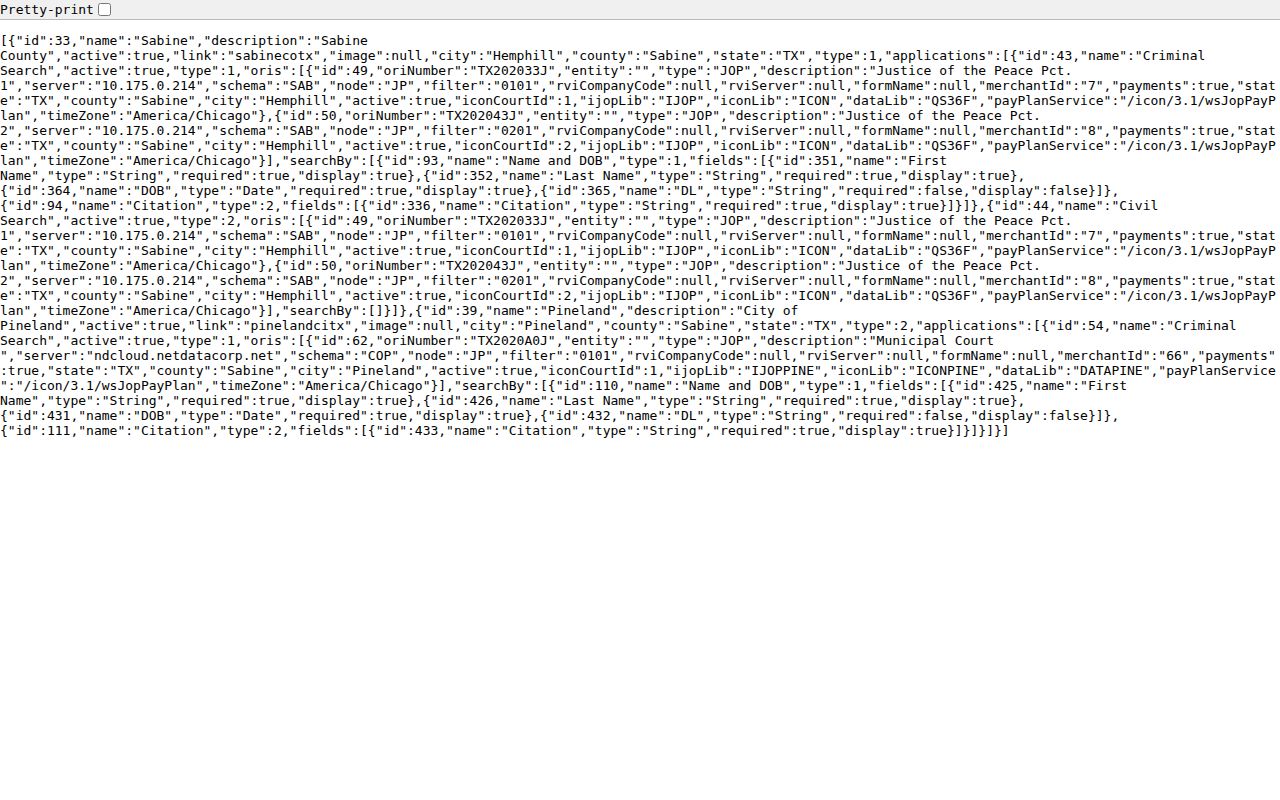
GovRec's Sabine portal is one door for lower-court search and payment. It lists JP Precinct 1 and JP Precinct 2 as NetData/ICON systems. A Pineland Municipal Court route appears too. The criminal search has a Name and DOB tab. That tab requires first name, last name, and date of birth. The Citation tab needs only the citation number. A Display Closed Cases control decides whether an old matter shows up. Labels include Case Information, Case Type, Citation Number, Court Name, Payment Information, and Pay Plan. Those fields describe one participating lower-court matter. They will not reach the District Clerk's felony register. If the right JP or city is unknown, use the county Justice Court page or call the likely clerk before entering more personal data. The official source view shows why scope matters.
Stages on a Criminal Docket
A district criminal case may open with a filing. From there the docket can show an indictment, arraignment or appearance, motions, discovery events, pretrial settings, a plea or trial, a judgment, and sentencing. Not every case takes every step. County and lower-court cases use different terms. Follow the dated event trail, and open the document behind a key entry when access permits.
Docket flow: Filing › Arraignment › Pretrial › Plea or Trial › Disposition › Sentencing
A reset or continuance just moves a setting. It does not dismiss the charge. A calendar line marked SABINE CRIMINAL likewise marks a block of court time, not a plea, verdict, or sentence for a named case.
Three Sabine County Criminal Docket Views
Three views answer three different questions. The August 2026 District Court calendar shows when a criminal call may occur. GovRec offers lower-court case or citation fields. The clerk's docket sheet gives the chronological record for the court that owns the case. The case file holds the real pleadings and judgment. Registered users can also try re:SearchTX for electronic documents that entered the statewide collection. It filters by county, court, case, and party where data exists. re:SearchTX is not a complete live docket. eFileTexas is different. It submits papers. It is not the public search. A missing electronic result can mean the record is paper-only, new, outside coverage, filed in another court, closed behind a filter, or legally restricted.
Which Court Holds Criminal Dockets
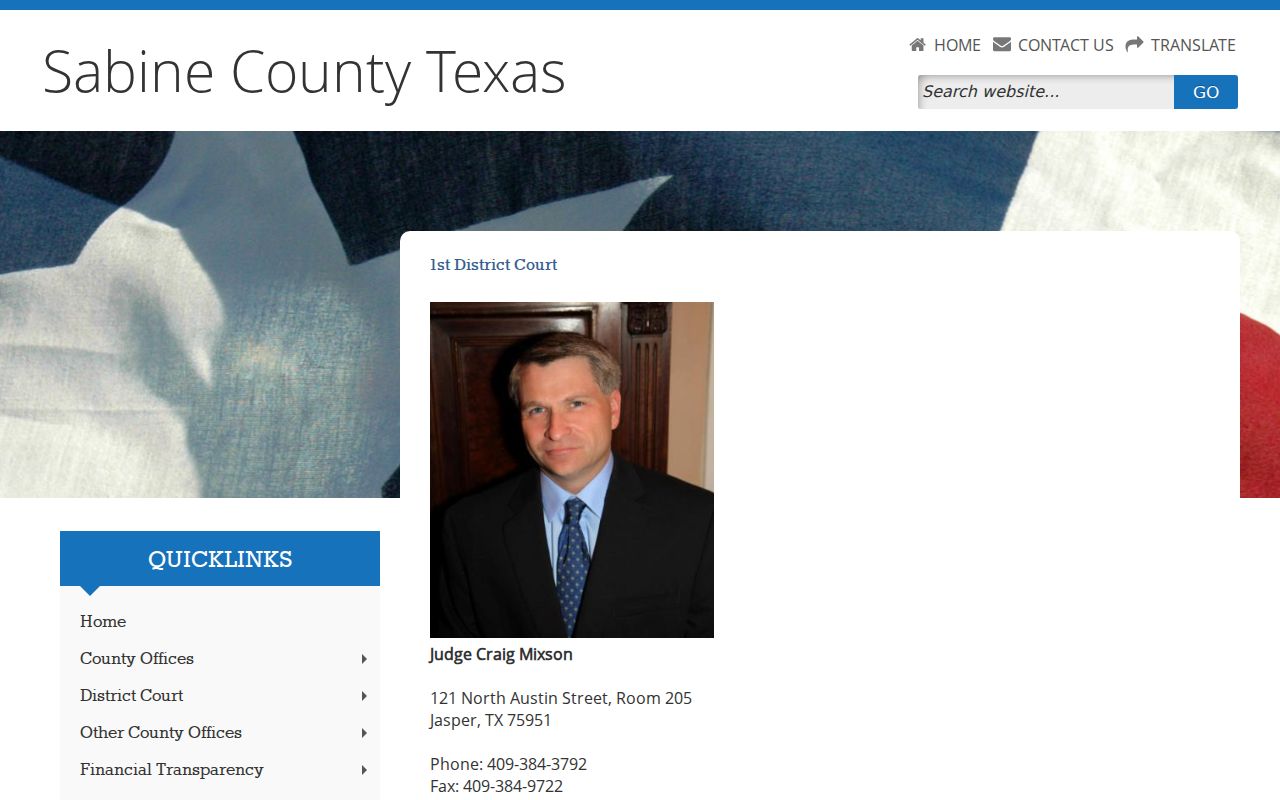
Felony charges in Sabine County land in one of two district courts, the 1st and the 273rd Judicial District Courts. Both courts span more than one county. A judge or a coordinator may sit in another county entirely, yet Lisa Pitre is the local clerk when a district case is filed in Sabine. The dockets there cover homicide, assault, robbery, burglary, theft, drug offenses, felony DWI, habeas matters, and other felonies described by the District Clerk.
Below the district level sits the Constitutional County Court, where Jamie Clark keeps the records. JP1 and JP2 handle Class C cases and citations. Hemphill and Pineland municipal courts take city ordinance and Class C matters. Each applies within its own city limits. Sabine County has no county court at law. So the court name and the offense level decide where a docket search should begin. The words "Sabine County" alone are not enough.
Sabine County Criminal Docket Counts
The OCA's FY2024 county-level district report for Sabine County counted 419 criminal matters active at the start, 11 reactivated, 255 added, 217 disposed, 23 placed inactive, and 339 ending within the report's accounting. Those are administrative statistics. They do not count people, convictions, warrants, or files you can pull up in a public docket search.
Numbers like these explain something. No single monthly calendar can stand in for the full Sabine County criminal docket. A docket search should also keep four things. Get the court, the cause number, the event date, and the exact document title. With those details, the clerk can separate one case record from the next without guesswork.
Treat the report as background, nothing more. "Added" means a matter entered the administrative count during the fiscal year. "Disposed" reflects reported movement under OCA definitions. Neither word tells you the plea, verdict, sentence, or dismissal in a particular file. For one Sabine County criminal case, read the docket events and get the judgment or order from the clerk who keeps it. Aggregate numbers cannot answer that.
Missing Sabine County Criminal Docket Results
An empty results screen is not proof that no case exists. Check the court, the precinct, the spelling, the cause or citation number, the date range, and the closed-case option. A municipal citation will never surface in a district felony search. A fresh filing may still be awaiting indexing. Sealed or protected records stay out of view by law.
Still nothing? Call the clerk who keeps the record. Request a docket sheet, a judgment, a sentencing order, or a certified disposition by name. Give the court and date range. Ask about fees before copies are run. For a wider workflow, the Sabine County case search lays out county and statewide routes and treats a portal summary as a pointer, never as the official file.
Sabine County Criminal Docket Access
Access to Sabine County criminal dockets has real limits. Sealed, expunged, non-disclosure, juvenile, child-protection, protected-identifier, and confidential material may be hidden or redacted. Missing from an online search does not mean sealed, dismissed, or cleared. Ask the clerk. A public docket, a redacted copy, or an access order may exist.
Texas access rules:
Texas Government Code Chapter 51 addresses district-clerk custody, recording, indexing, preservation, and certification duties.
OCA's open-records policy explains that court case records differ from ordinary county administrative records.
Rule 12 of the Rules of Judicial Administration governs certain non-case judicial records, not the filed case itself.
Sabine County accepts written Public Information Act requests for county administrative records by mail, fax, email, or hand delivery to the right elected official. A docket sheet, a filed motion, or a judgment belongs to the court clerk keeping that case instead. Ask about current copy, delivery, and certification terms first.
Keep the request narrow so it routes cleanly. Name the court, the cause or citation number, the document title, the event date, the date range, the format you want, and whether a plain or certified copy will do. Get a fee quote before any work starts. Skip emailing sensitive personal identifiers unless the clerk points you to a secure channel. If access is denied, ask which authority applies. Ask whether a redacted public copy can be released.